Key Takeaways
- A 91% fall in European league attendances over 2020-21 led to transfer spending dropping by over 40% in the 2021 summer transfer window
- Just three clubs out of 32 ‘European Elite’ clubs remained profitable over the two seasons worst-hit by the pandemic, while FC Barcelona recorded the greatest operating loss in football history
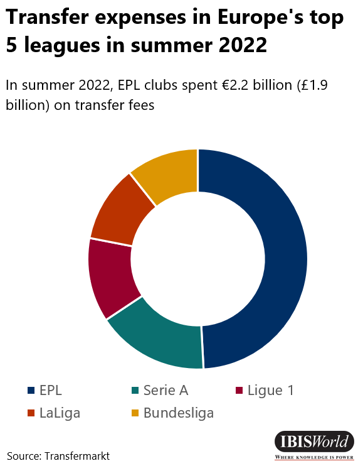
- The English Premier League spent approximately €2.2 billion on transfer fees in the 2022 summer window – roughly equal to the top divisions in France, Germany, Italy and Spain combined
The football world stopped dead in its tracks in March 2020 as COVID-19 swept from country to country. European league attendances tanked by 91% over the following 2020-21 season, with gate receipts dropping from 12% of revenue to just 2%. The pandemic wreaked havoc on the finances of clubs across Europe, reflected by transfer expenditure falling off a cliff over the 2021 summer transfer window, down 41% on 2019.
To manage the shortfall in revenue, LaLiga (Spain) and Ligue 1 (France), agreed deals with CVC Capital Partners for respective 8.2% and 13% shares in the league鈥檚 media rights. Some clubs turned to cash reserves, while others renegotiated short term liabilities into long term liabilities to meet their financial obligations.
Out of the 32 鈥楨uropean Elite鈥� clubs, only three returned profits in both 2019-20 and 2020-21, according to Football Benchmark.
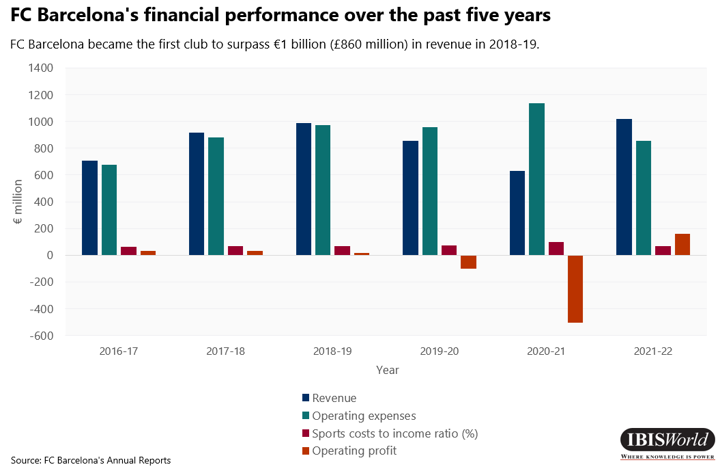
Spanish giant, FC Barcelona, recorded a combined operating loss of 鈧�605 million (拢521.6 million) over the two years, including 鈧�505 million (拢435.4 million) in 2020-21, making it the largest loss in football history.
FC Barcelona鈥檚 financial turmoil
FC Barcelona became the first club to surpass 鈧�1 billion (拢860 million) in revenue in 2018-19. So, how did such a successful club find itself in financial disarray? A history of poor decision making and presidential turnover coincided with the pandemic, created the perfect storm culminating in over 鈧�1 billion (拢860 million) of debt.
Not all debt is bad debt 鈥� the nature of the debt paints a more accurate picture than its size. A considerable share of FC Barcelona鈥檚 debt was short term liabilities - over 鈧�100 million (拢86 million) in transfer fees and 鈧�266 million (拢229.3 million) in bank loans due in the near future. This prompted club president, Joan Laporta, to announce the club was 鈥渃linically dead鈥� in March 2021. By August 2021, the club had amassed 鈧�1.3 billion (拢1.1 billion) in debt and its sports costs to income ratio reached 103% - having been just 61% in 2016-17.
LaLiga operates a squad cost limit (SCL). The amount each club can spend on their squad is found by taking operating expenses and debt repayments away from revenue. Unlike most financial rulings, the SCL is proactive, meaning clubs can鈥檛 register new players if they exceed the set limit.
With the club鈥檚 finances hit by COVID-19 and debt repayments, FC Barcelona eagerly signed a lucrative shirt and stadium sponsorship deal with Spotify, in March 2022, worth approximately 鈧�280 million (拢240 million). Despite this, FC Barcelona remained 鈧�144 million (拢124 million) over its SCL in summer 2022.
FC Barcelona activated its palancas (financial levers), selling 25% of its LaLiga broadcasting revenue for the next 25 years to Sixth Street and 10% of Barca Studios broadcasting revenue to Socios.com for 鈧�110 million (拢94.8 million). The palancas saved the club from bankruptcy and helped build a competitive squad.
However, the club essentially bet its future on the establishment of a European Super League (ESL). The club remains at an operating deficit of 鈧�200 million (拢172 million) due to its enormous wage costs. Joining the ESL 鈥� where founding members would receive a 鈧�1 billion bonus 鈥� would resolve the club鈥檚 financial woes in an instant.
Nevertheless, a so-called 鈥榮uper league鈥� appears to have already emerged out of the financial storm induced by COVID-19 鈥� the English Premier League (EPL).
Broadcasting money machine 鈥� the EPL
Propped up by its highly remunerative broadcasting rights deals, English clubs were involved in 42% of the total value of global transfers during the 2021 summer window. The EPL was the only one out of the ten largest markets to exceed 70% of 2019 spending levels, as per the figures presented in Deloitte鈥檚 Annual Review of Football Finance 2022.
In 2022-23, a new three-cycle of broadcasting rights began.
While other leagues agreed to discounted deals, the EPL carried over its domestic package and secured a 30% rise to the value of its international packages.
The Times reported that the domestic package would be worth 拢5.1 billion and the international package would hit 拢5.3 billion. The EPL鈥檚 total broadcasting revenue is projected to exceed LaLiga鈥檚 and the Bundesliga鈥檚 put together, reflecting the sheer enormity of the league鈥檚 popularity.
In summer 2022, after a full season with fans and on the back of the new broadcasting deal, EPL clubs spent 鈧�2.2 billion (拢1.9 billion) on transfer fees, surpassing its previous record (2017-18) by approximately 拢500 million. For comparison, this roughly equaled the collective spending of the four other biggest leagues 鈥� LaLiga (鈧�516 million), Bundesliga (鈧�489 million), Seria A (鈧�756 million) and Ligue 1 (鈧�566 million).
Based on enterprise value, 10 out of the 32 European Elite clubs play their football in the EPL, according to Football Benchmark.
The EPL is striding away from the rest of the top European leagues and its new broadcasting deals will only add to the distance.
The takeover of Newcastle United by Saudi Arabia鈥檚 Public Investment Fund and the sporting momentum achieved by head coach Eddie Howe will help the club break into the European Elite by 2023-24.
Further, the country鈥檚 two most successful clubs, Liverpool and Manchester United, are both for sale. New ownership for Liverpool would likely see a shift away from the club鈥檚 sell-to-buy regime whereas for Manchester United it would see much needed investment in the club鈥檚 facilities, boosting the competitiveness of both clubs. Europe鈥檚 first super league is here already and looks set to stay.