
In the early 1970s, Canadian scientists created canola, derived from the words 鈥淐anadian鈥� and 鈥淥la,鈥� by conventionally breeding rapeseed plants to create a new plant with a better nutritional profile. Canola quickly garnered a reputation for its versatility, such as providing stable feed for animals and its use in household products such as ink, soap, and other cosmetics. The crop gained further popularity due to its low levels of saturated fats and use as biodiesel to power heavy machinery.聽
Due to canola鈥檚 multifaceted use, it has become a major contributor to Canada鈥檚 economic wellbeing, with 90.0% of the country鈥檚 canola production exported to global markets. In fact, Canada is one of the largest exporters of canola worldwide, accounting for more than 50.0% of global canola exports. More than 43,000 Canadian farmers rely on canola as a source of income and more than 207,000 jobs are attributed to canola production, according to the Canola Council of Canada.
Decreased Canola Production
Canadian canola is mainly produced in the Prairies region due to the area鈥檚 ideal soil conditions. However, ongoing drought conditions and higher temperatures have compromised the soil in western Canada, detrimentally affecting the region鈥檚 canola production.
Additionally, labour shortages due to the COVID-19 (coronavirus) pandemic have contributed to the fall in canola production. According to the Crop Condition Assessment Program鈥檚 satellite technology that models crop yields and productions, overall plant health in western Canada is much lower than normal.聽 聽In fact, canola production is expected to decrease an annualized 8.2% to 12.8 million metric tonnes over the five years to 2021, reaching its lowest level since 2008 when production totalled 12.7 million metric tonnes. Ultimately, total Canadian canola production is expected to fall 34.4% in 2021 alone, primarily due to poor weather conditions prohibiting the crop from flourishing.
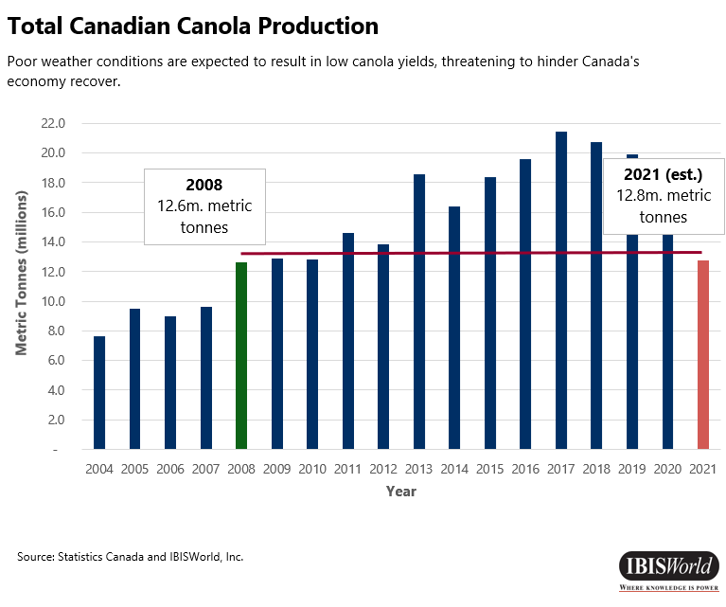
In addition to the many farmers relying on canola production for their incomes, the shortage has caused the price of canola to sky rocket. Between October 2020 and October 2021, the price of canola has increased 69.2% to $909.8 per metric tonnes. Due to canola鈥檚 variety of uses, the increased price has trickled down to a plethora of other products, contributing to inflation.
As prices rise and production falls, Canadian exports of canola are expected to suffer. In 2020, canola exports accounted for an estimated $11.9 billion (latest data available). Thus, a decline in canola exports is expected to severely hinder Canada鈥檚 economic recovery.
Overall, canola is a vital crop for the Canadian economy and helps uphold the economies of provinces that depend on this crop鈥檚 production and uses. Such provinces include Saskatchewan, Alberta and Manitoba, which are anticipated to account for 45.3%, 33.8% and 19.7% of Canadian canola production, respectively, in 2021. As droughts and rising temperatures prolong in the Prairies, Canada鈥檚 canola production is expected to dwindle to its lowest levels since 2008.